SlipPad
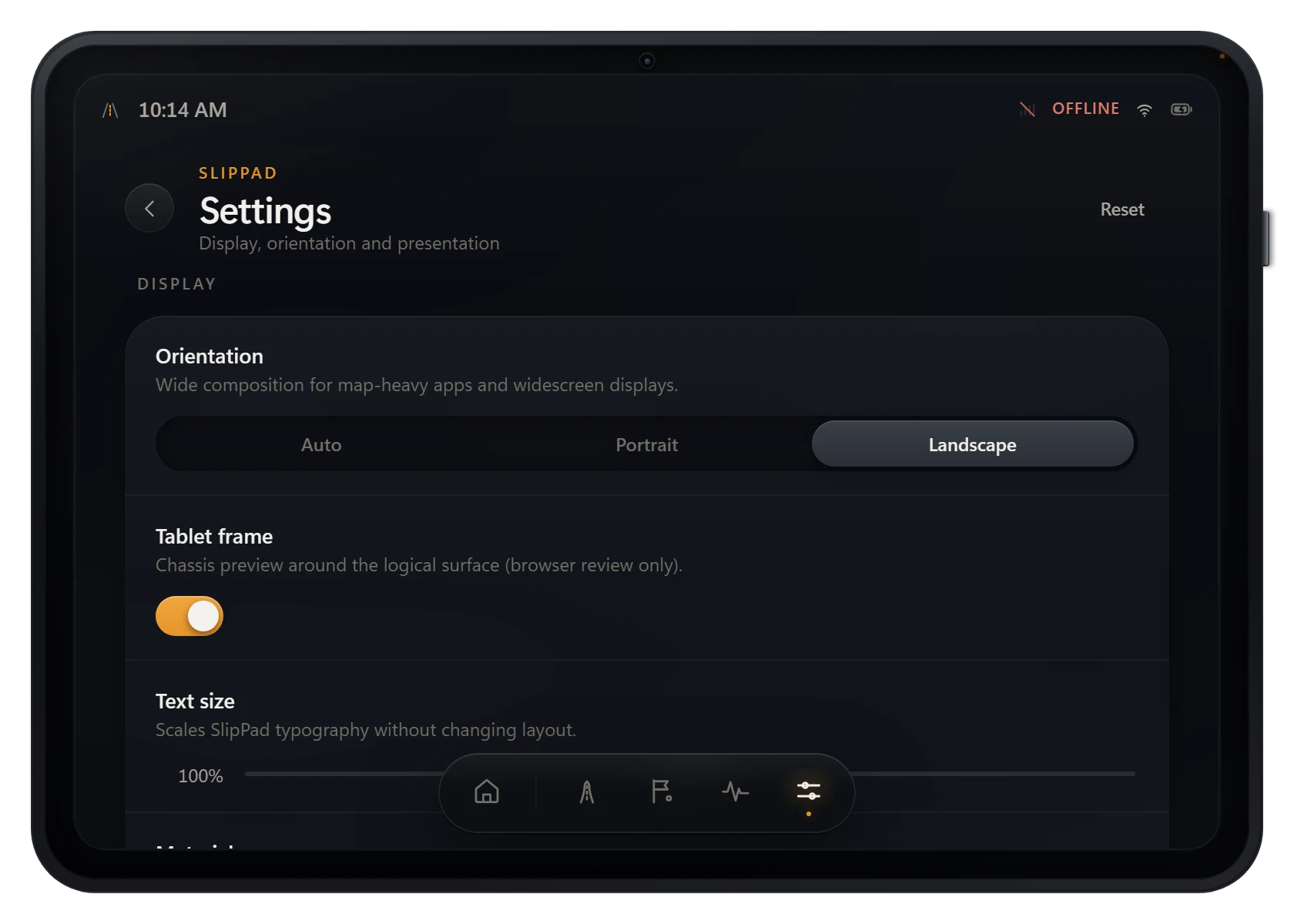
A real tablet experience inside the drive — portrait and landscape, a lock screen, home, settings and a Quick HUD — running on the native desktop host over the simulator.
Now
Sliproad is in active development. This page is a snapshot of what works today, what is being built now, and what comes next.
The next milestone for Sliproad is navigation: matching your vehicle to the road network, planning a route, and keeping you on it while you drive.
The groundwork is already in place. Roads are read from the game's own world data and were matched against the live vehicle position during a real drive — with no manual offset. The junction geometry foundation that navigation will sit on is complete and validated against that recorded data.
Planned for this milestone:
It is the active priority. The first full authored chapter — Route 66 — is sequenced after this work.
What already works — built, tested and in several cases validated during real American Truck Simulator drives.
A real tablet experience inside the drive — portrait and landscape, a lock screen, home, settings and a Quick HUD — running on the native desktop host over the simulator.
Quests, activities, rules and journeys — structured drives with objectives and checkpoints, challenges scored 0–100 from real telemetry, and multi-stage trips with progress that survives restarts.
Road geometry read from the game's own world data, aligned with live vehicle telemetry — tested during an actual drive, with the live marker following the vehicle without manual offset calibration.
The geometric foundation that relates the vehicle's position to the rest of the road network — including the complex interiors of junctions. Validated against the recorded drive data with zero worsened valid samples.
September 2026
The geometric foundation for navigation — including the interior of complex junctions — was completed and validated against the drive data recorded earlier. Every sample matched or improved: zero regressions.
Portrait and landscape operation, a lock screen, home, settings and native usability were consolidated into the current tablet experience — and validated on the native host in a real ATS session.
Sliproad's extracted road geometry was tested during an actual drive: the rendered map matched the environment, and the live vehicle marker followed without manual offset calibration.
The Journey system landed on top of activities — linear stages, persistent progress and crash-safe restoration, proven end to end in automated runs.
Challenges gained real rules — speed limits and target times — a deterministic 0–100 score computed from telemetry, and a verification policy that reports data gaps instead of ignoring them.
The full loop — pick a drive, follow the checkpoints, finish, see the result — was completed during real ATS drives, with progress surviving a restart.
Build notes are curated, not a feed — only product-meaningful events appear here.